A deck is not a deliverable. I know how it feels to think it is: you build a clean, well-argued asset, you hand it to Sales, and something in you counts the task as done. But if the only thing you've measured is that the asset exists, you've measured the wrong thing.
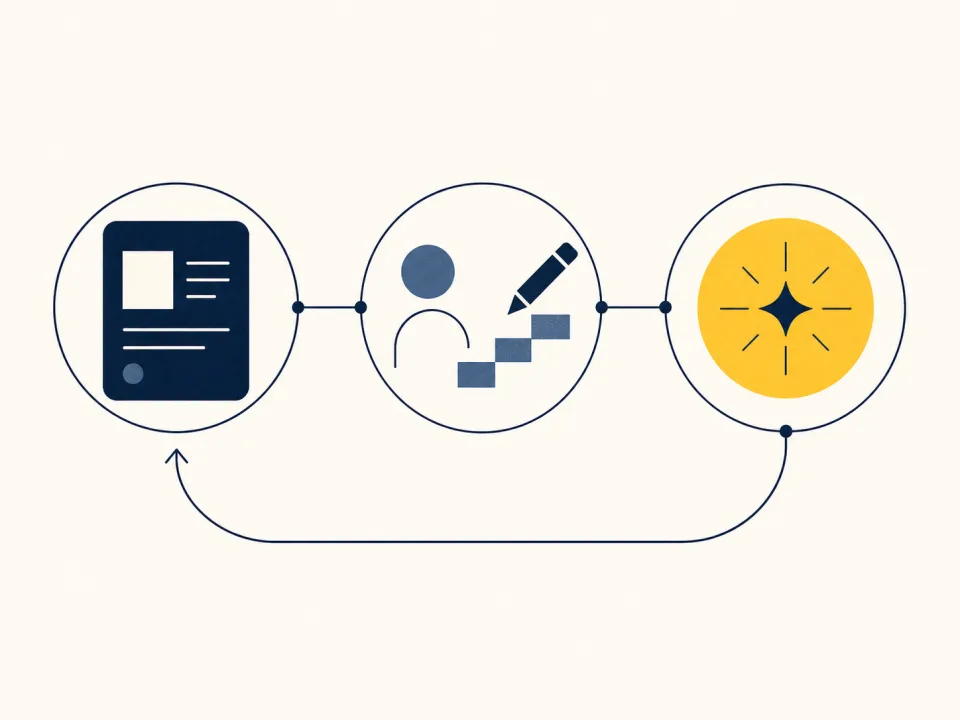
The deliverable was never the asset. It was adoption. And adoption is roughly one-third content, one-third training, and one-third follow-up. Skip either of the last two and the first was mostly wasted effort.
Content has to earn attention
The content itself has to earn attention on its own terms: useful, easy to understand, concise. A salesperson under time pressure won't fight through something dense to find the point.
The content is more than a document. For a demo, the deliverable includes:
- a realistic use case;
- the slides or Notion page that tell the story where visual depth is needed;
- a short script laying out the main talking points.
That's the first third.
Training creates the adoption path
The second third is the one almost everyone skips: training. Handing someone an asset and assuming they'll use it well is a hope, not a plan. People adopt a tool when they've been walked through it, when they've seen it used, and when they've had the chance to ask the question they didn't know they had.
Follow-up closes the loop
The last third is follow-up, and it's where you find out whether any of it worked. I borrow the discipline from product adoption: every asset should have a purpose, an adoption path, and a way to verify it landed.
Concretely, if salespeople rated their confidence in a new demo at one out of four before, I check later whether that number moved, and whether the improvement shows up in commercial outcomes, not just in how they feel. If it didn't move, the asset failed, however good it looked. Output is not the same as outcome, and I'd rather know an asset failed than admire it on a shelf.
One example sharpens what content can and can't do. I once built a discovery deck with questions, objection handling, and supporting slides, and it was useful for building trust and moving quickly. But I came to a conclusion that changed how I think about enablement: if a salesperson leans heavily on slides during a discovery conversation, they've probably already lost the quality of the interaction. At most, one slide belongs in a discovery call. The best enablement sometimes tells you to put the asset down.
Where the claim stops
The thirds are a way of thinking, not an accounting rule. Some assets need heavy training and little follow-up; some are one-off and disposable by design, built to create trust fast even though you know they won't last.
What doesn't change is the principle underneath: if you produce something without asking how people will adopt it and how you'll know it worked, you've misunderstood the objective.